Author Archives: SMS

Influential Reads – March 2023

Reading Time: 3 minutes

Influential Reads – March 2023

“If you’re going to panic, panic first.” – Old adage

Well, March was exciting.  Inflation and bank failures…a recipe for…the stock market to crush it?

In my first full month of semi (?) retirement, we had a bunch of house guests and made a short trek up to Ketchum, Idaho for some skiing at Sun Valley and skating at Galena Lodge .  

Here are my most influential reads for the month – in no particular order:

  1. Satyajit Das: SVB Collapse and Bank Turmoil – Latest Chapter in the Unwinding – “The assumption that raising rates and withdrawing monetary stimulus would result in a painless adjustment back to a new normal was naïve in the extreme.”  SMS here: It’s not just the change in magnitude, it’s the velocity.
  2. Dissecting Goldman’s gory $2.25bn SVB equity issue – “Second, the stock offering has to be underwritten. Hard-underwritten. Or already subscribed-for. Investors must assess the equity offering on the basis of a repaired balance sheet. They must know you don’t actually need them.”
  3. The Powell of Positive Thinking – “He clearly signaled (again) that once Fed overnight policy rates reach a peak, they would not be declining for a while. “
  4. Risk Capital and Markets: A Temporary Retreat or Long Term Pull Back? – “It behooves both investors and traders to therefore track movements in risk capital, since it is will determine when long term bets on value will pay off for the former, and the timing of entry into and exit from markets for the latter.”
  5. Highlights from Charlie Munger’s Conversation with Todd Combs (2022 Singleton Prize for CEO Excellence) – “It’s the nature of things that a bunch of democratically-elected politicians will eventually print too much money.”
  6. Free Money Turned Brains to Mush, Now Some Banks Fail – “And when I say “free money” with regards to banks, I mean it literally.  Since 2008, banks have been borrowing from depositors at 0% interest or near 0% interest. Even today, even as some banks are trying to attract more deposits by offering higher interest rates, even today when the Fed’s short-term rates are near 5%, the average interest rate on savings accounts is still only 0.4%. Even today, 0.4%.” SMS: This is nuts.
  7. Venture Catastrophists – “There are no libertarians in foxholes.”
  8. Is Inflation Mean-Reverting? – “What that means – and it is super important – is that inflation has momentum. Keep in mind that during most of the period shown here, the Federal Reserve was actively trying to make inflation mean-revert. And they didn’t succeed, at least on a one-year basis.”
  9. Banking Woes Hark Back to the S&L Crisis of the 1980s – “Former Fed Reserve Chairman Paul Volcker used high rates to squeeze inflation out of the economy four decades ago, and the savings & loan industry was among the unintended victims. “
  10. The easiest way to spot a market bubble – “New Metrics get invented while timeless investing principles become a thing of the past.”  See Cash EBITDA. SMS: During the sale of my business last year, the investment bankers wanted me to use “Cash EBITDA”, but they could not even provide a definition.

Note: This is based on when I read the article, not necessarily when it was first published.  Unfortunately, my backlog of things I would like to read always seems to dwarf the amount of time I can devote to reading.

Top clicks across the site last month:

  1. Financial Model vs. Operating Model
  2. Bears Watching: Short Yields & Fed Funds Rate
  3. Excel Tips: Football Field Chart
  4. Operating Model Tips
  5. Email: Don’t Fire & Forget

Updated stats:

Read ArticlesBooks
January800
February622
March672
April
May
June
July
August
September
October
November
December
Total2094

Bears Watching: Short Yields & Fed Funds Rate

Reading Time: < 1 minute

Wow. Stunning collapse in short duration yields.

Source: Marketwatch.com

Over 100 bps on the two year.

And what is even more interesting to me is the gap between the current Fed Funds target rate and these rates:

Source: Bloomberg.com

Seems like that is going to need to resolve itself somehow, at some point.

Are Credit Conditions Tightening Again?

Reading Time: 2 minutes

Despite the Fed raising interest rates, credit conditions were actually relaxing on some levels in the back half of 2022.

“Financial conditions have loosened significantly in recent months and, by some measures, are around levels that prevailed last March when the Fed initiated this hiking cycle.” – Why the Federal Reserve Should Raise Rates by Half a Percent

Equities were rallying through this period, unsurprisingly.  So, were digital bit apes and other assorted things.

However, there appears to be evidence that credit conditions are now heading the other way:

  1. “The Federal Reserve has reduced its balance sheet by $626 billion since the peak in April 2022, with total assets now down to $8.34 trillion, the lowest since August 2021, according to the weekly balance sheet released today. Compared to a month ago, total assets dropped by $94 billion.” “Over the past four weeks, the Fed has shed $61.2 billion in Treasury securities, exceeding by a smidgen the monthly cap of $60 billion.” – Fed’s Balance Sheet Drops by $626 Billion from Peak
  2. “The only time conditions have tightened this much has been in advance of or during the last 4 recessions since 1990.” – Credit conditions in Q4 were recessionary
  3. “As it stands, the average lender is now back up into the low 7’s for a well-qualified 30yr fixed scenario. These aren’t the highest levels we’ve seen during this cycle, but they are the highest in more than 4 months (and not too far away from the long-term highs just under 7.4%).” – Calculated Risk: “Mortgage Rates Now Back Above 7%”

We have had a 15 year bull market with low interest rates and lots of liquidity.  In other words, “Disneyland.”

My sense is most market participants are going to be slow to change how they learned to behave during the bull market cycle, until they are forced to do so.  

Influential Reads – February 2023

Reading Time: 3 minutes

Influential Reads – February 2023

“Standards apply not just to the quality of work you produce but the opportunities you work on. If you accept substandard work from yourself, you’ll only get average work from others. If you say yes to average projects, you’ll have no time for exceptional ones.” – Brain Food, Farnam Street

Big news in my world: I resigned my CFO role at a private equity backed software maker after selling the business to a new private equity group.  I will be taking some time off to “to evaluate, to collect, to dream, to wonder and to wander.”

Reading and writing more is definitely a goal.

Here are my most influential reads for the month – in no particular order:

  1. Jim Chanos: The Golden Age of Fraud in Finance – ” One of the things that is as old as financial markets is that we don’t see oversight or new laws and regulations until after people lose money.”
  2. “Disinflation” Hoopla Sunk by Spiking Prices – “Not only did all the relevant measures get a lot worse in January, but the prior three months, October through December, were revised higher – much like the CPI inflation readings a couple of weeks ago – showing substantially greater inflation momentum at the end of the year than originally shown.”
  3. The Wisdom of Non-Effort – “Non-effort is letting yourself take a walk and notice what comes up for you as something to write about, and trusting that”
  4. Just Twenty-Five Pages a Day – “The solution I devised for myself is a simple one: 25 pages a day. That’s it. Just commit to that, and then do it.”
  5. Buffett Profile from 1979: “The investor’s investor” – “The essence of Warren Buffett’s thinking is that the business world is divided into a tiny number of wonderful businesses well worth investing in at a price and a huge number of bad or mediocre businesses that are not attractive as long-term investments.”
  6. When TIPS Outperform and How I Invest in Them – “TIPS outperform regular Treasuries when the market underestimates future inflation.”
  7. We Are All Bond Traders Now – “What this means is that if interest rates are low, you care a great deal about the interest rate. Any change to your numerator is easily wiped out by a small change in the interest rate you are discounting at.”
  8. The Forgotten Lessons of 2008: Seth Klarman – “You must buy on the way down. There is far more volume on the way down than on the way back up, and far less competition among buyers. It is almost always better to be too early than too late, but you must be prepared for price markdowns on what you buy.”
  9. Enough Part 2 – A Framework – Calibrating Capital – “Too many of us run too hard for too long, reaching a point of exhaustion (or worse) when we could have taken a breather (or several of them) long ago.”
  10. Microsoft and the Metaverse – “I suspect that this is the path that virtual reality will take. Like PCs, the first major use case will be knowledge workers using devices bought for them by their employer, eager to increase collaboration in a remote work world, and as quality increases, offer a superior working environment.”

Note: This is based on when I read the article, not necessarily when it was first published.  Unfortunately, my backlog of things I would like to read always seems to dwarf the amount of time I can devote to reading.

Top clicks across the site last month:

  1. Sign of the Times: New Homes For Rent
  2. Financial Model vs. Operating Model
  3. Excel Tips: Football Field Chart
  4. Operating Model Tips
  5. Influential Reads – January 2023

Updated stats:

Read ArticlesBooks
January800
February622
March
April
May
June
July
August
September
October
November
December
Total1422

Influential Reads – January 2023

Reading Time: 2 minutes

On Reading More “The solution I devised for myself is a simple one: 25 pages a day. That’s it. Just commit to that, and then do it.” – Farnam Street

Well, that is one way to start the new year.  Set a few goals.  Miss them all.

Certainly behind on the book reading front.  Also, want to maintain an average of writing one article a week.  And behind on that one.

So there is no where to go but up!

Big news is in the works on the career front.  That one is actually going according to plan here in February.  More to come once the fat lady sings.

Here are my most influential reads for the month – in no particular order:

  1. After a Timeout, Back to the Meat Grinder! – “Now things get more complicated. While the most extreme froth has been wiped off the market, valuations are still nowhere near their long-term averages.”
  2. Why the Federal Reserve Should Raise Rates by Half a Percent – “Financial conditions have loosened significantly in recent months and, by some measures, are around levels that prevailed last March when the Fed initiated this hiking cycle.”
  3. Why Competitive Advantages Die – “The only thing harder than gaining a competitive edge is not losing that advantage when you have one.”
  4. How to Get New Ideas – “The way to get new ideas is to notice anomalies: what seems strange, or missing, or broken?”
  5. On Email and Horses – “The right question is not, is this useful? But instead, how do we want to use it?”
  6. The Federal Reserve Is Trimming Its Assets. It’s Not Working – ” The Fed’s QT has had relatively little effect on financial conditions since it got under way last year. And in a surprising twist, the new battle over the nation’s debt limit will largely negate any impact QT might produce”
  7. Inflation, Rising Interest Rates Brought End to Cheap Money – “Cheap money—an incredibly popular and influential feature of finance that led to a surge of wealth, speculative trading and booms in ridiculous investments such as   meme stocks and   digital images of cartoon monkeys—died suddenly in 2022. It was 14 years old. Cheap money is survived by its estranged relative, expensive money.”
  8. Rental Housing Is Suddenly Headed Toward a Hard Landing – “Why has the rental market turned so weak? As rental housing economist Jay Parsons points out, new lease demand cratered in the second half of the year, and was negative for the full year for the first time since 2009.”
  9. 2023 is the Year of _________ – “2023 is a pivotal year for many startups. Churchill once said, “Never let a good crisis go to waste.””  SMS here: SFTE could turn out to be a pivotal year for the family; need a moto.
  10. The Critical Question – “They assume you’re price sensitive, and expect you to ask why something doesn’t cost less…but they are not expecting you to ask why something doesn’t costmore.”

Note: This is based on when I read the article, not necessarily when it was first published.  Unfortunately, my backlog of things I would like to read always seems to dwarf the amount of time I can devote to reading.

Top clicks across the site last month:

  1. Financial Model vs. Operating Model
  2. Excel Tips: Football Field Chart
  3. Excel Template: Bridge Waterfall
  4. Book Report: The Hard Thing About Hard Things
  5. Operating Model Tips

Updated stats:

Read ArticlesBooks
January800
February
March
April
May
June
July
August
September
October
November
December
Total800

That’s A Bunch of…

Reading Time: < 1 minute

Attempting to avoid some of the politics here, I would like to pose a question:

Where haven’t they found classified documents?

Another question, again, attempting to avoid the politics of the situation:

Who the hell is in charge of securing classified documents in this country?

Excel Template: Bridge Waterfall

Reading Time: < 1 minute

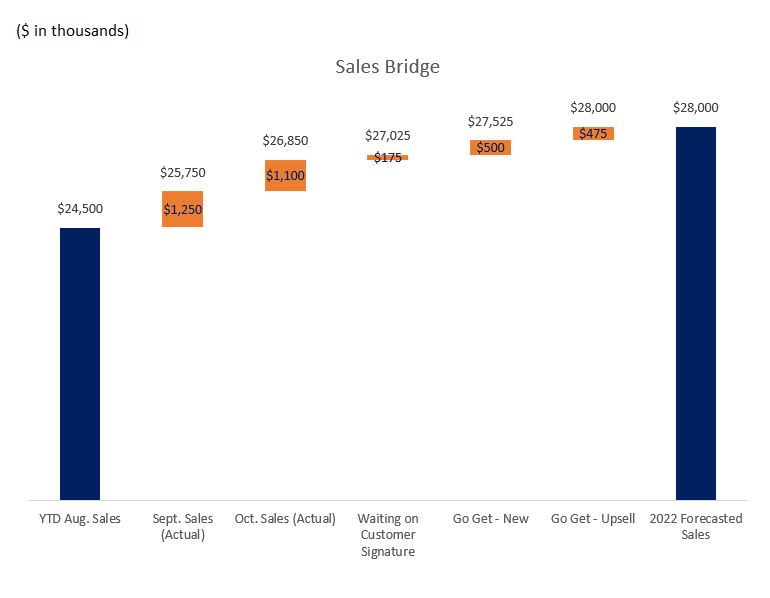
A quick post this week of another excel template.

This is often called a bridge or waterfall and is a fairly common way to present a “walk” to a target or goal.

Available on Gumroad.

Please see some others here:

  1. Excel Template: Stacked Bar Chart with Total
  2. Excel Template: Football Field Chart
  3. Maturity Schedule

These are downloadable on Gumroad at no cost.  

Drop a note in the comments if there is something excel that you would like to see.  No promises.  

Remember, you get what you pay for…

Influential Reads – December 2022

Reading Time: 2 minutes

“We tend to assume that the worst that has happened is the worst that can happen, and then prepare for that. We forget that “the worst” smashed a previous understanding of what was the worst..” – Brain Food: Figuring it Out (https://fs.blog/brain-food/december-11-2022/)

Happy New Year!

First post of 2023.  I’ve set a goal for posting more.  Competing priorities last year, especially the fourth quarter, hampered my ability to read, write, and post.  

However, we successfully sold the business to a new set of investors, delivering a great outcome for our prior shareholders.  So with that behind me, I hope to be spending more time here.

Note on the book reading front – I did knock out the entire Travis McGee series.

Here are my most influential reads for the month – in no particular order:

  1.  Take Calculated Risks – “Making an unconventional decision can be a very lonely action. Yet, when the person making it has intimate knowledge of a situation and has calculated the risks involved, it often proves to be precisely the right one.”
  2. 3Q 2022 GMO Quarterly Letter – ” Looked at in this way, it seems as if a value strategy in the U.S. should be avoiding the “shallow value” stocks that are mildly cheap relative to the market and focusing solely on the “deep value” quintile. “
  3. Summary of My Post-CPI Tweets – “Overall Core ex-housing (which includes core goods) is down to 5.2% y/y. That’s the lowest since…well, September 2021. Going the right direction but unless core services start to decelerate, there’s a limit to how good this picture can be.”
  4. The Fed is Dead – “In fact, rather than slowing corporate price increases, the Fed’s rate hikes seem to be having the opposite effect.”
  5. Billionaire David Tepper Is Betting Against the Stock Market Because of the Federal Reserve – ” I think the upside/downside [risk here] just doesn’t make sense to me when I have so many central banks telling me what they are going to do”
  6. Q&A with Scott Reardon: Great Investor Track Records – “Generally they were looking for companies where free cash flow yield + growth rate equaled 20% or more. In other words, they were looking for returns double the market average, which is exactly what all of them achieved over their long careers.”
  7. How private markets became an escape from reality – “Private equity firms reported gains of about 3 per cent this year, when public markets were down 20 per cent or more and tighter money battered all markets similarly.”
  8. How to Hedge Inflation and Avoid the Biggest Bond Risk – “Inflation is the biggest long-term risk for bond investors.”
  9. BNP Paribas studied 100 years of market crashes – “A typical recession bear market is 1.5 years in length, with a median drawdown of 38% and a median peak in the VIX of 40.5. “
  10. TeamDynamix Secures Investment to Deliver Rapid Innovation for IT Automation – ” TeamDynamix, a leading IT automation provider, today announced that it has secured an investment from New York-based Level Equity Management while existing investor, K1 Investment Management, will roll a material portion of its proceeds from its exit into the business.”

Note: This is based on when I read the article, not necessarily when it was first published.  Unfortunately, my backlog of things I would like to read always seems to dwarf the amount of time I can devote to reading.

Updated stats:

Read ArticlesBooks
January891
February1100
March1023
April1032
May1343
June740
July822
August1127
September724
October614
November815
December765
Total1,09636